Quantum Computing’s Impact on Data Encryption by 2026: An Insider’s Guide
Understanding Quantum Computing’s Impact on Data Encryption by 2026: An Insider’s Guide
The dawn of quantum computing is not just a scientific curiosity; it’s a looming revolution with profound implications for every facet of our digital lives. Among its most significant impacts is the potential to render current data encryption methods obsolete. As we approach 2026, the urgency to understand and prepare for this shift is paramount. This insider’s guide will delve into the anticipated impact of quantum computing on data encryption, outlining the threats, emerging solutions, and strategic steps businesses and individuals must take to secure their digital future.
The Quantum Threat: Why Current Encryption is Vulnerable
For decades, our digital security has relied on the mathematical complexity of algorithms like RSA and Elliptic Curve Cryptography (ECC). These algorithms are unbreakable by classical computers within a practical timeframe due to the sheer number of computations required. However, quantum computers operate on fundamentally different principles, leveraging phenomena such as superposition and entanglement. This allows them to perform certain calculations exponentially faster than even the most powerful supercomputers.
Shor’s Algorithm and Its Implications
At the heart of the quantum threat lies Shor’s algorithm, discovered by Peter Shor in 1994. This algorithm, when run on a sufficiently powerful quantum computer, can efficiently factor large numbers and solve the discrete logarithm problem. These are precisely the mathematical problems underpinning RSA and ECC, respectively. If a quantum computer capable of running Shor’s algorithm at scale becomes a reality, it would effectively break much of the public-key cryptography that secures:
- Online banking and financial transactions
- Secure communication (VPNs, TLS/SSL for websites)
- Digital signatures and identity verification
- Government and military communications
- Critical infrastructure control systems
- Cloud data storage
The timeline for when such a quantum computer will exist is a subject of intense debate among experts. While some predict it’s still decades away, others, including intelligence agencies, suggest that cryptographically relevant quantum computers could emerge within the next 5-10 years. This brings us squarely to the 2026 timeframe, making Quantum Encryption 2026 a critical concern for proactive planning.
Grover’s Algorithm and Symmetric Encryption
While Shor’s algorithm targets asymmetric (public-key) encryption, Grover’s algorithm poses a threat to symmetric encryption schemes like AES (Advanced Encryption Standard). Grover’s algorithm can significantly speed up the search for a key in a symmetric encryption system. While it doesn’t break AES in the same fundamental way Shor’s algorithm breaks RSA, it effectively halves the security strength. For example, a 256-bit AES key would offer the equivalent security of a 128-bit key against a quantum attack. This means that current symmetric key lengths may need to be doubled to maintain the same level of security in a post-quantum world.
The Race for Post-Quantum Cryptography (PQC)
Recognizing the impending threat, cryptographers worldwide are engaged in a vigorous race to develop and standardize new encryption algorithms that are resistant to quantum attacks. This field is known as Post-Quantum Cryptography (PQC) or Quantum-Resistant Cryptography. The goal is to create cryptographic schemes that are secure against both classical and quantum computers.
NIST’s Standardization Process
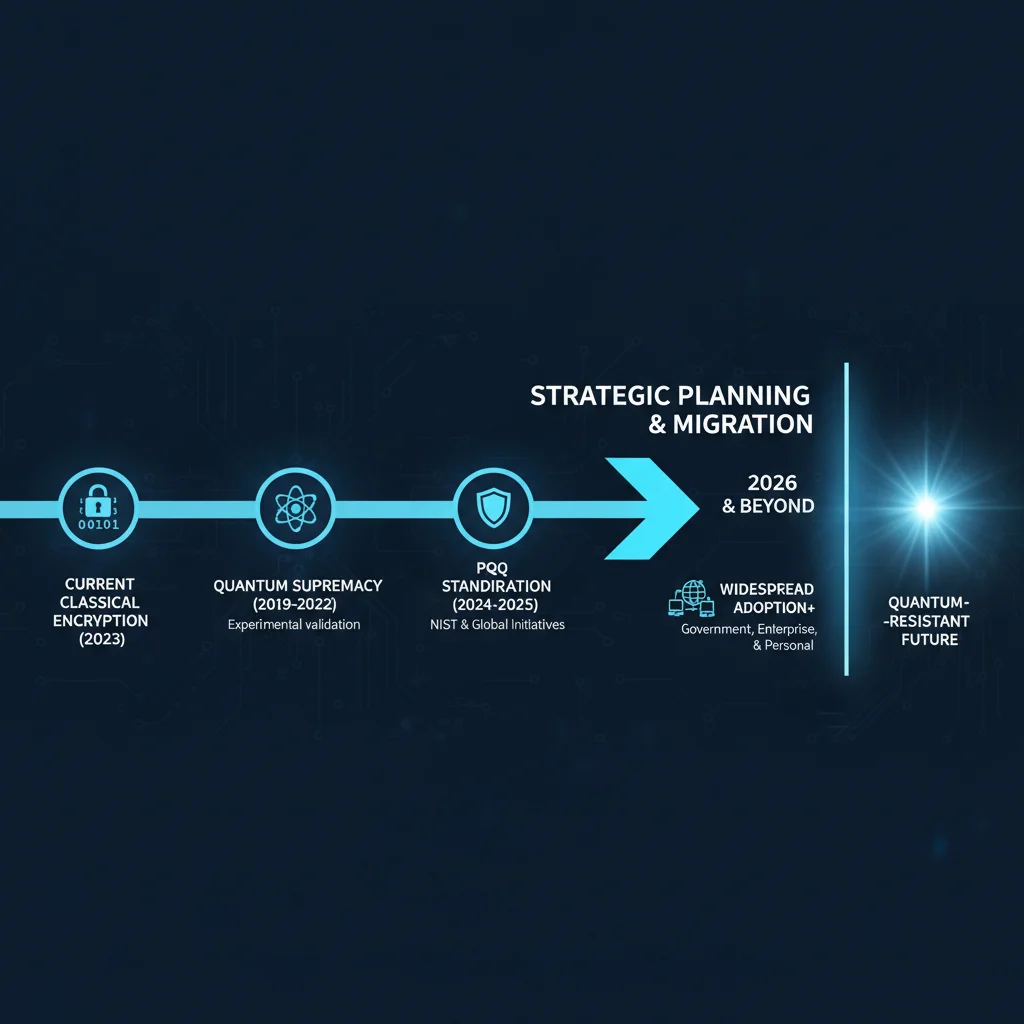
The U.S. National Institute of Standards and Technology (NIST) has been at the forefront of this effort, launching a multi-year process to solicit, evaluate, and standardize PQC algorithms. This process began in 2016 and has involved several rounds of submissions and analysis from cryptographers globally. As of late 2023, NIST has selected several algorithms for standardization, with others still under consideration. These selected algorithms are based on different mathematical problems that are believed to be hard for quantum computers to solve, such as lattice-based cryptography, code-based cryptography, and hash-based cryptography.
By 2026, we anticipate that the first set of PQC standards will be fully established and ready for widespread adoption. This marks a critical juncture for organizations to begin migrating their systems to these new algorithms. The transition will be complex, requiring significant planning, resources, and testing. It’s not simply a matter of swapping out one algorithm for another; it often involves changes to protocols, hardware, and software architectures.
Types of Post-Quantum Cryptography
The PQC landscape is diverse, with various families of algorithms being explored:
- Lattice-based Cryptography: These algorithms rely on the difficulty of solving certain problems in high-dimensional lattices. They are highly efficient and show great promise for both encryption and digital signatures. Examples include CRYSTALS-Kyber (key encapsulation) and CRYSTALS-Dilithium (digital signatures), both selected by NIST.
- Code-based Cryptography: Based on error-correcting codes, these schemes offer robust security but often come with larger key sizes. McEliece is a well-known example.
- Hash-based Cryptography: These schemes derive security from cryptographic hash functions. They are generally considered very secure and are particularly useful for digital signatures, but they have the drawback of being stateful (requiring careful management of public/private key pairs to prevent reuse). XMSS and SPHINCS+ are examples.
- Multivariate Polynomial Cryptography: These systems are based on solving systems of multivariate polynomial equations over finite fields.
- Isogeny-based Cryptography: These algorithms leverage the mathematics of elliptic curve isogenies. While promising, they are generally more complex and computationally intensive.
Each of these families has its own strengths and weaknesses in terms of security, performance, and key/signature sizes. Organizations will need to carefully evaluate which PQC algorithms are best suited for their specific applications and environments as the Quantum Encryption 2026 deadline approaches.
Strategic Preparation: Navigating the Quantum Transition by 2026
The transition to post-quantum cryptography is not a task that can be left until the last minute. The sheer scale of the cryptographic infrastructure that needs to be updated globally means that organizations must start planning and preparing now. Here’s a strategic roadmap for businesses to navigate the quantum transition by 2026:
1. Inventory and Audit Cryptographic Assets
The first step is to gain a comprehensive understanding of where cryptography is used within your organization. This involves:
- Identifying all systems, applications, and protocols that rely on public-key cryptography (e.g., TLS/SSL, VPNs, digital signatures, code signing, encrypted data at rest).
- Cataloging the specific cryptographic algorithms and key lengths currently in use.
- Understanding data classification: which data needs long-term protection (e.g., government secrets, intellectual property, personal health information) and therefore has a longer ‘shelf life’ for encryption. This is crucial because data encrypted today with classical algorithms could be vulnerable to quantum attacks in the future if harvested now (the ‘harvest now, decrypt later’ threat).
- Mapping dependencies: understanding which systems rely on which cryptographic modules and where third-party integrations introduce cryptographic elements.
2. Develop a Quantum-Readiness Roadmap
Based on the inventory, organizations need to develop a detailed roadmap for migrating to PQC. This roadmap should include:
- Risk Assessment: Prioritize systems and data based on their exposure to quantum threats and the impact of a cryptographic breach.
- Pilot Programs: Begin testing PQC algorithms in non-production environments. This allows for early identification of compatibility issues, performance impacts, and integration challenges.
- Budget Allocation: Secure the necessary financial resources for software upgrades, hardware replacements, and personnel training.
- Vendor Engagement: Communicate with technology vendors to understand their PQC migration plans and ensure that future products and services will be quantum-resistant.
- Talent Development: Invest in training cybersecurity teams on PQC principles and implementation strategies.
3. Implement Cryptographic Agility
Cryptographic agility refers to the ability of systems to easily switch between different cryptographic algorithms. This is a critical principle for the quantum transition because:
- It allows organizations to adopt new PQC algorithms as they are standardized without requiring a complete system overhaul.
- It provides a fallback mechanism if a chosen PQC algorithm is later found to be vulnerable.
- It enables hybrid modes, where classical and PQC algorithms are used in parallel to provide a layered defense during the transition period. This ‘hybrid’ approach is likely to be a common early deployment strategy, combining the known security of classical algorithms with the quantum-resistance of new PQC ones.
Building cryptographic agility into new systems and retrofitting it into existing ones should be a priority. This ensures that your infrastructure is flexible enough to adapt to the evolving cryptographic landscape, especially in the lead-up to and beyond Quantum Encryption 2026.
4. Consider Quantum Key Distribution (QKD) and Quantum Random Number Generators (QRNGs)
While PQC focuses on software-based algorithms, Quantum Key Distribution (QKD) offers a hardware-based approach to secure key exchange. QKD leverages quantum mechanics to detect any eavesdropping attempts, theoretically providing unconditionally secure key distribution. Similarly, Quantum Random Number Generators (QRNGs) provide truly random numbers, which are essential for strong cryptographic keys.
While QKD and QRNGs have their own challenges (e.g., distance limitations for QKD, cost), they represent additional layers of defense that organizations may consider for extremely sensitive data. They are complementary to PQC, not a replacement, offering a robust multi-faceted approach to quantum-resistant security.
The ‘Harvest Now, Decrypt Later’ Threat
One of the most insidious aspects of the quantum threat is the ‘harvest now, decrypt later’ scenario. Adversaries, including state-sponsored actors, could be collecting vast amounts of encrypted data today, knowing that they do not have the capability to decrypt it yet. Their strategy is to store this data until a sufficiently powerful quantum computer becomes available, at which point they can retroactively decrypt it.
This threat is particularly relevant for data with a long shelf life, such as classified government information, intellectual property, medical records, or financial data. Any data that needs to remain confidential for more than a few years is potentially at risk from this scenario. This underscores the urgency of migrating to PQC, not just for future communications but also for protecting existing archives of sensitive data. Implementing PQC for data at rest and for long-term archives is a critical step in mitigating this risk well before 2026.
Impact on Specific Industries
The impact of Quantum Encryption 2026 will not be uniform across all sectors. Some industries, due to the nature of their data and regulatory requirements, will feel the pressure more acutely:
- Finance: Banks, investment firms, and payment processors rely heavily on encryption for secure transactions and customer data protection. A breach could lead to massive financial losses and a complete loss of trust.
- Healthcare: Patient health information (PHI) is highly sensitive and requires long-term confidentiality. Quantum attacks could expose decades of medical records.
- Government and Defense: National security, intelligence, and military communications depend on unbreakable encryption. The compromise of these systems could have catastrophic consequences.
- Critical Infrastructure: Energy grids, water treatment facilities, and transportation networks are increasingly digitized and rely on secure communication. Quantum threats could enable attacks on these vital systems.
- Technology and Intellectual Property: Companies dealing with highly valuable R&D, trade secrets, and proprietary algorithms need to protect their intellectual property for extended periods.
Each industry will need to assess its unique risk profile and develop a tailored PQC migration strategy. Collaboration within industry groups and with government bodies will be crucial for sharing best practices and coordinating efforts.
Conclusion: Securing the Digital Future Beyond 2026
The advent of quantum computing represents a fundamental shift in the landscape of cybersecurity. While the full capabilities of quantum computers are still evolving, the potential threat to current data encryption methods is clear and present. By 2026, the first wave of standardized post-quantum cryptographic algorithms will be available, marking a critical deadline for organizations to begin their transition.
Proactive planning, comprehensive inventorying of cryptographic assets, the development of robust quantum-readiness roadmaps, and the implementation of cryptographic agility are not merely recommendations; they are essential survival strategies for the digital age. Ignoring the implications of Quantum Encryption 2026 would be a grave oversight, potentially leading to devastating data breaches and a complete erosion of trust.
The journey to a quantum-resistant future is complex, but it is a journey that must be undertaken. By understanding the threats, embracing emerging solutions, and strategically preparing, businesses and individuals can ensure the continued confidentiality, integrity, and authenticity of their digital information in the face of the quantum revolution. The time to act is now, to secure not just today’s data, but also the data of tomorrow.