Cybersecurity Threats 2026: Critical Vulnerabilities for US Digital Infrastructure

The digital landscape is an ever-evolving battlefield, and as we approach 2026, the stakes for US digital infrastructure have never been higher. The interconnectedness that defines modern society, while offering unparalleled convenience and efficiency, simultaneously creates a vast attack surface for malicious actors. From nation-state adversaries seeking geopolitical advantage to sophisticated cybercriminal organizations driven by profit, the threats are diverse, persistent, and increasingly complex. Understanding these evolving challenges is not merely an academic exercise; it is a critical imperative for safeguarding national security, economic stability, and the daily lives of American citizens. This comprehensive analysis delves into the most critical cybersecurity threats anticipated to challenge US digital infrastructure in 2026, offering insights into their nature, potential impact, and crucial mitigation strategies. The focus will be on three overarching categories of vulnerabilities that demand immediate and sustained attention from both public and private sectors.
The protection of US Digital Infrastructure is a multifaceted challenge, requiring a holistic approach that encompasses technological advancements, policy frameworks, and human vigilance. As we navigate the complexities of the coming years, the ability to anticipate and adapt to new threats will be paramount. This article aims to equip readers with a deeper understanding of the threat landscape, fostering a proactive mindset essential for robust digital defense.
The Escalating Threat of Nation-State Cyber Warfare
One of the most profound and concerning threats to US Digital Infrastructure in 2026 emanates from nation-state actors. These sophisticated adversaries possess significant resources, advanced capabilities, and often, a strategic long-term vision that extends beyond immediate financial gain. Their motivations are varied, ranging from espionage and intellectual property theft to destabilizing critical infrastructure and influencing political processes. The methods employed are increasingly stealthy and persistent, making attribution and defense exceptionally challenging.
Advanced Persistent Threats (APTs) and Espionage
Nation-state-sponsored Advanced Persistent Threats (APTs) continue to evolve, becoming more adept at evading detection and maintaining long-term footholds within targeted networks. In 2026, we can expect to see an increase in APT groups leveraging zero-day exploits, supply chain compromises, and sophisticated social engineering tactics to infiltrate government agencies, defense contractors, research institutions, and critical infrastructure operators. The objective is often to exfiltrate sensitive data, gain strategic intelligence, or lay the groundwork for future disruptive attacks. The sheer volume and complexity of data being generated and stored by US Digital Infrastructure make it an irresistible target for such espionage campaigns.
For instance, an APT group might spend months, or even years, meticulously mapping a target network, identifying key personnel, and developing custom malware designed to blend seamlessly with legitimate network traffic. Their focus isn’t on a quick smash-and-grab but on maintaining persistent access to continuously gather intelligence. This requires a shift in defensive strategies from merely blocking initial attacks to actively hunting for persistent threats within networks, utilizing advanced threat intelligence, behavioral analytics, and AI-driven anomaly detection.
Critical Infrastructure Targeting and Destabilization
The targeting of critical infrastructure – including energy grids, water treatment facilities, transportation networks, and financial systems – represents a direct threat to national security and public safety. Nation-state actors may seek to disrupt these systems to exert political pressure, sow chaos, or demonstrate capability. The increasing digitization and interconnectedness of these operational technologies (OT) with traditional IT networks create new vulnerabilities. A successful attack on even a single component of US Digital Infrastructure could have cascading effects, leading to widespread outages, economic disruption, and potentially, loss of life.
In 2026, we anticipate more sophisticated and coordinated attacks on critical infrastructure, moving beyond simple denial-of-service to highly targeted, multi-stage campaigns designed to cause physical damage or prolonged operational paralysis. The Stuxnet incident serves as a stark reminder of the potential for cyberattacks to have real-world, kinetic consequences. Future attacks will likely be even more advanced, leveraging automation and potentially artificial intelligence to identify vulnerabilities and execute complex attack sequences at machine speed. Protecting this vital US Digital Infrastructure demands a confluence of robust technical controls, rigorous incident response planning, and strong public-private partnerships.
Information Warfare and Disinformation Campaigns
Beyond direct technical attacks, nation-states will continue to wield information warfare as a potent weapon against US Digital Infrastructure. This includes large-scale disinformation campaigns designed to erode public trust, influence elections, and create societal divisions. Social media platforms, news outlets, and even legitimate government communication channels can be exploited to spread false narratives, often amplified by automated bots and AI-generated content. The goal is to manipulate public perception and undermine democratic processes, ultimately weakening the fabric of the nation. The ability to discern truth from falsehood in a hyper-connected world becomes a critical component of national resilience, making education and media literacy vital countermeasures.
The Expanding Surface of Supply Chain Attacks
The intricate web of global supply chains represents a significant and growing vulnerability for US Digital Infrastructure. Modern software, hardware, and services are rarely monolithic; instead, they are composed of countless components, libraries, and sub-systems sourced from a multitude of vendors, often across international borders. A single compromise at any point in this extended supply chain can have far-reaching consequences, potentially infecting thousands of organizations downstream without their direct knowledge or consent. This ‘trust but verify’ paradigm is increasingly being challenged, as adversaries recognize the immense leverage gained by compromising a trusted supplier.
Software Supply Chain Compromises
The SolarWinds attack in 2020 served as a wake-up call, demonstrating the devastating potential of compromising widely used software. In 2026, we anticipate an acceleration of such attacks, with adversaries focusing on popular open-source libraries, development tools, and software update mechanisms. Injecting malicious code into a legitimate software package allows attackers to bypass traditional perimeter defenses and gain access to a vast number of unsuspecting targets. The proliferation of DevOps and agile development methodologies, while enhancing speed, can also introduce new risks if security is not integrated throughout the software development lifecycle (SDLC).
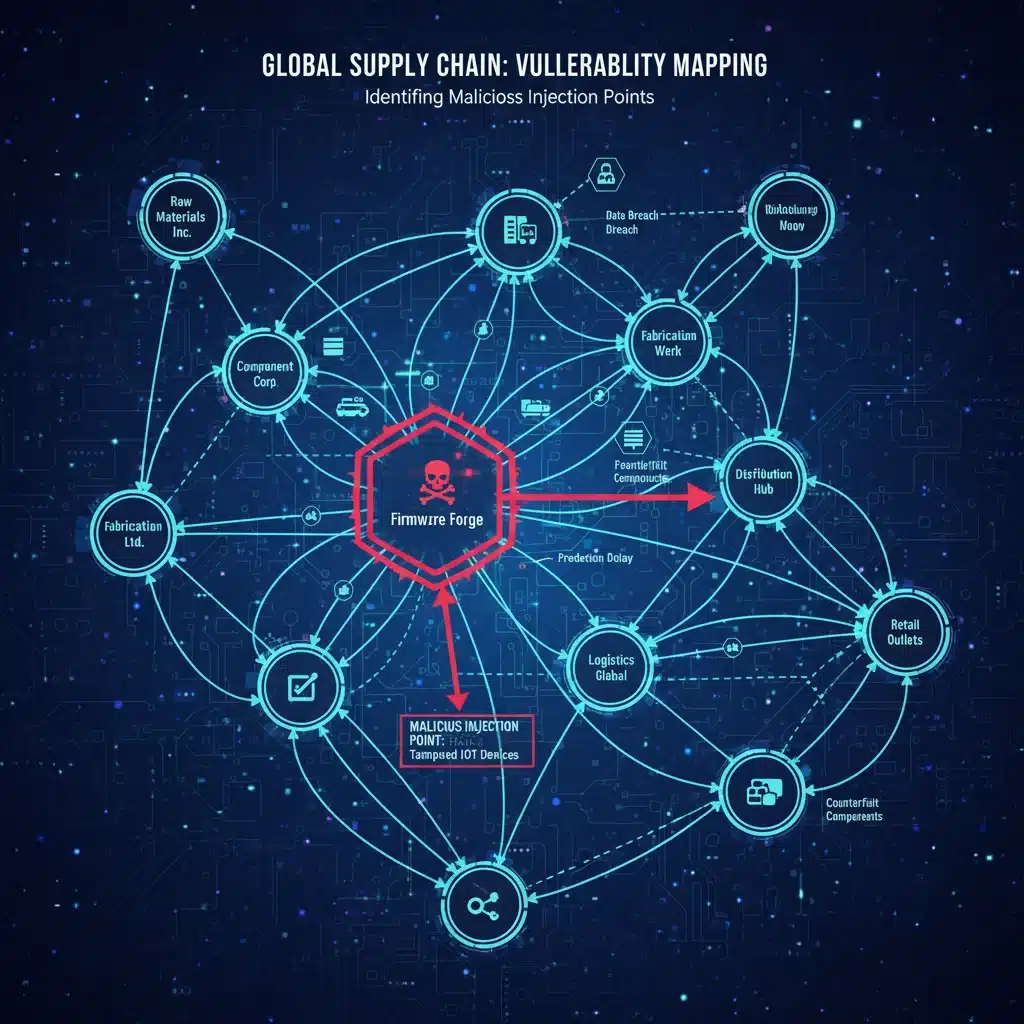
Securing the software supply chain for US Digital Infrastructure requires a multi-layered approach: rigorous code review, software bill of materials (SBOM) generation, continuous vulnerability scanning, and robust integrity checks at every stage. Organizations must demand transparency from their software vendors and implement processes to verify the security posture of all third-party components. Without these measures, the risk of a single point of failure leading to widespread compromise remains dangerously high.
Hardware and Firmware Tampering
Beyond software, the physical hardware and embedded firmware that underpin US Digital Infrastructure also present significant supply chain vulnerabilities. Adversaries could introduce malicious components during manufacturing, tamper with devices during transit, or compromise firmware updates to create backdoors or introduce surveillance capabilities. Detecting such compromises requires highly specialized expertise and equipment, making it a particularly insidious threat. The reliance on global manufacturing hubs for critical hardware components further complicates this challenge, necessitating robust verification processes and diversified sourcing strategies.
Imagine a scenario where a critical network router, essential for the functioning of a segment of US Digital Infrastructure, contains a hidden chip that allows an adversary to remotely control it or intercept data. Such a compromise could be incredibly difficult to detect and even harder to remediate without physically replacing the tainted hardware. This highlights the need for trusted hardware initiatives and greater scrutiny of the entire hardware lifecycle, from design to deployment.
Third-Party and Managed Service Provider (MSP) Risks
Organizations increasingly rely on third-party vendors and Managed Service Providers (MSPs) for a wide range of IT functions, from cloud hosting to security monitoring. While this outsourcing can offer efficiency and specialized expertise, it also extends the attack surface. A compromise of an MSP, which often has privileged access to numerous client networks, can serve as a conduit for widespread attacks. In 2026, we expect adversaries to intensify their focus on MSPs as high-value targets, recognizing them as a force multiplier for their campaigns against US Digital Infrastructure.
Establishing stringent security requirements for third-party vendors, conducting regular security audits, and implementing robust access controls (including least privilege and multi-factor authentication for all vendor access) are crucial. Furthermore, organizations must ensure that their contracts with MSPs include clear accountability for cybersecurity incidents and robust incident response protocols. The weakest link in the chain often determines the overall security posture, and in the case of US Digital Infrastructure, that link can often be found within the extended ecosystem of third-party providers.
The Double-Edged Sword of Artificial Intelligence (AI)
Artificial Intelligence (AI) is rapidly transforming every sector, and cybersecurity is no exception. While AI offers immense potential for enhancing defensive capabilities, it also presents a formidable new weapon for cyber attackers. In 2026, the dual nature of AI will become even more pronounced, creating both unprecedented opportunities and significant challenges for protecting US Digital Infrastructure.
AI-Powered Cyberattacks
Adversaries are increasingly leveraging AI and machine learning (ML) to automate and enhance their attack capabilities. This includes AI-driven phishing campaigns that generate highly personalized and convincing lures, AI-powered vulnerability scanning that can identify weaknesses at an accelerated pace, and autonomous malware that can adapt and evolve to evade detection. The speed and scale at which AI can operate could overwhelm traditional human-centric defense mechanisms. For example, an AI-powered attack could conduct reconnaissance, identify vulnerabilities, craft exploits, and execute an attack in a fraction of the time it would take human attackers, making real-time detection and response critical for US Digital Infrastructure.
Furthermore, AI can be used to develop polymorphic malware that constantly changes its signature, making it extremely difficult for traditional signature-based antivirus solutions to detect. AI could also be employed to analyze network traffic and learn the behavior of legitimate users, allowing it to mimic those behaviors and blend in, making it an ideal tool for persistent espionage or data exfiltration. The arms race between offensive and defensive AI capabilities will define a significant portion of the cybersecurity landscape in the coming years, necessitating continuous innovation in defensive AI for US Digital Infrastructure.
Evasion of AI-Based Defenses
As defensive AI solutions become more prevalent, attackers will simultaneously focus on developing techniques to evade them. This includes adversarial AI, where attackers manipulate input data to trick AI models into making incorrect predictions or classifications. For instance, an attacker might subtly alter malicious code in a way that makes an AI-driven intrusion detection system classify it as benign, allowing it to bypass defenses. This creates a continuous cycle of innovation where defensive AI must constantly adapt to counter new adversarial techniques.

The integrity and robustness of AI models used for cybersecurity are paramount. Attacks on the AI models themselves, such as data poisoning or model evasion, could compromise the very systems designed to protect US Digital Infrastructure. Ensuring the trustworthiness and resilience of AI in cybersecurity will require rigorous testing, explainable AI (XAI) techniques, and a deep understanding of adversarial AI methodologies.
The Ethical and Governance Challenges of AI in Cybersecurity
Beyond the technical aspects, the widespread adoption of AI in cybersecurity also raises significant ethical and governance questions. Who is accountable when an AI system makes an incorrect decision that leads to a security breach or an unwarranted intervention? How do we ensure transparency and prevent bias in AI-driven security tools? The potential for autonomous AI systems to make decisions with far-reaching consequences necessitates careful consideration and the development of robust ethical guidelines and regulatory frameworks. The responsible deployment of AI for protecting US Digital Infrastructure will be as crucial as its technical capabilities.
Proactive Defense Strategies for US Digital Infrastructure
Addressing these critical cybersecurity threats in 2026 requires a multi-pronged, proactive, and adaptive approach. Relying solely on reactive measures will be insufficient to protect the vast and complex US Digital Infrastructure.
Strengthening Cyber Resilience and Redundancy
Building cyber resilience means designing systems that can withstand and recover quickly from cyberattacks, rather than simply trying to prevent them entirely. This involves implementing robust backup and recovery strategies, diversifying critical systems, and building redundancy into networks and infrastructure. For critical infrastructure, this also means developing offline capabilities and manual overrides that can be activated in the event of a severe cyberattack. The ability of US Digital Infrastructure to continue operating, even in a degraded state, is vital for national security.
Enhanced Threat Intelligence Sharing and Collaboration
No single entity can combat these threats alone. Effective defense of US Digital Infrastructure necessitates enhanced information sharing and collaboration between government agencies, private sector companies, and international partners. This includes sharing actionable threat intelligence, indicators of compromise (IOCs), and best practices in real-time. Platforms like Information Sharing and Analysis Centers (ISACs) play a crucial role in facilitating this exchange, allowing organizations to learn from each other’s experiences and collectively raise the bar for security.
Investing in Workforce Development and Education
The cybersecurity talent gap remains a significant challenge. Addressing the sophisticated threats of 2026 requires a highly skilled and continuously trained workforce. This means investing in cybersecurity education at all levels, from K-12 programs to advanced university degrees, as well as fostering continuous professional development for existing cybersecurity professionals. A robust human firewall is as important as technological defenses for US Digital Infrastructure. Furthermore, general cybersecurity awareness training for all employees, from the mailroom to the boardroom, is essential to mitigate the risk of social engineering attacks.
Adopting a Zero Trust Architecture
The traditional perimeter-based security model is increasingly obsolete in a world of cloud computing, remote work, and complex supply chains. A Zero Trust architecture assumes that no user, device, or application can be implicitly trusted, regardless of its location. Every access request is authenticated, authorized, and continuously validated. Implementing Zero Trust principles across US Digital Infrastructure will significantly reduce the attack surface and limit the lateral movement of adversaries once they gain initial access.
Leveraging Advanced Security Technologies
The fight against AI-powered attacks requires equally advanced defensive tools. This includes the deployment of AI-driven anomaly detection, behavioral analytics, Security Orchestration, Automation, and Response (SOAR) platforms, and Extended Detection and Response (XDR) solutions. These technologies can help organizations detect and respond to threats at machine speed, providing a crucial advantage against rapidly evolving attack vectors. Continuous research and development in quantum-resistant cryptography will also become increasingly important for protecting sensitive data within US Digital Infrastructure from future threats.
Policy and Regulatory Frameworks
Robust policy and regulatory frameworks are essential for setting minimum security standards, promoting best practices, and ensuring accountability across US Digital Infrastructure. This includes clear guidelines for critical infrastructure protection, data privacy regulations, and international agreements for cyber warfare. Governments must work with industry to create an environment that fosters innovation in cybersecurity while simultaneously enforcing necessary safeguards. International cooperation on cyber norms and attribution will also be vital in deterring nation-state aggression.
Conclusion: A Call to Action for US Digital Infrastructure Security
The cybersecurity landscape in 2026 will be characterized by an intensified arms race, with nation-state actors, cybercriminals, and AI-powered threats pushing the boundaries of offensive capabilities. The protection of US Digital Infrastructure is not a static goal but a continuous process of adaptation, innovation, and collaboration. The three critical vulnerabilities discussed – escalating nation-state cyber warfare, the expanding surface of supply chain attacks, and the double-edged sword of artificial intelligence – demand immediate and sustained attention.
By proactively investing in cyber resilience, fostering robust threat intelligence sharing, developing a skilled workforce, adopting Zero Trust principles, leveraging advanced security technologies, and establishing strong policy frameworks, the United States can build a more secure and resilient digital future. The challenges are immense, but with a concerted and unified effort, the integrity and functionality of US Digital Infrastructure can be safeguarded against the threats of tomorrow.