Decentralized Social Media: Top 3 Platforms in the US by 2026
The Rise of Decentralized Social Media: A Comparison of 3 Platforms Gaining Traction in the US by Early 2026
In an era increasingly defined by digital interactions, the concept of social media has evolved dramatically. For years, centralized platforms like Facebook, Twitter (now X), and Instagram have dominated the landscape, offering unparalleled connectivity but often at the cost of user data privacy, algorithmic manipulation, and centralized control over content and moderation. However, a significant shift is underway. The burgeoning interest in decentralized social media is not just a trend; it’s a fundamental re-imagining of how we connect online, promising greater user autonomy, transparency, and resistance to censorship.
By early 2026, the United States is witnessing a notable acceleration in the adoption and discussion around several key decentralized social media platforms. These platforms leverage blockchain technology or similar distributed ledger systems to create a more equitable and resilient online environment. This article delves into the phenomenon of decentralized social media, exploring its core principles and providing an in-depth comparison of three platforms currently gaining significant traction in the US: Mastodon, Bluesky, and Farcaster. We will examine their unique architectures, user experiences, and what makes them compelling alternatives to the established giants.
Understanding Decentralized Social Media: A Paradigm Shift
Before diving into specific platforms, it’s crucial to grasp the foundational concepts of decentralized social media. Unlike traditional social networks, which operate on central servers owned and controlled by a single corporation, decentralized platforms distribute data and control across a network of individual servers or nodes. This architectural difference has profound implications:
- User Ownership and Control: Users typically have more control over their data and identity. There’s no single entity that can unilaterally delete your account or censor your content (though individual server administrators might still have local control).
- Censorship Resistance: Because there’s no central point of control, it’s much harder for any single government or corporation to shut down or censor an entire network. If one server goes offline, others can continue to operate.
- Interoperability: Many decentralized platforms are designed to be interoperable, meaning different applications or servers can communicate with each other, fostering a more open and connected internet.
- Transparency: The underlying protocols are often open-source, allowing anyone to inspect how the system works and contribute to its development.
- Community-Driven Moderation: While still evolving, many decentralized platforms empower communities to set and enforce their own moderation policies, moving away from top-down corporate decisions.
The appeal of decentralized social media stems from a growing disillusionment with the current state of mainstream social networks. Concerns over data breaches, privacy violations, algorithmic echo chambers, and the immense power wielded by a handful of tech giants have fueled a demand for alternatives that prioritize user rights and open protocols. The move towards decentralized social media represents a broader shift towards Web3, a vision of the internet built on decentralization, blockchain technologies, and token-based economics.
Mastodon: The Fediverse’s Flagship in Decentralized Social Media
Mastodon has been a prominent player in the decentralized social media space for several years, often cited as a prime example of the ‘Fediverse’ – a portmanteau of ‘federation’ and ‘universe.’ Launched in 2016, Mastodon gained significant attention during periods of controversy on centralized platforms, particularly Twitter, as users sought refuge in its more community-centric model.
How Mastodon Works:
Mastodon operates on the ActivityPub protocol, an open, decentralized social networking protocol. Instead of a single website, Mastodon consists of thousands of independent servers (called ‘instances’) run by individuals, communities, or organizations. Users choose an instance to join, which then becomes their home on the Fediverse. Each instance has its own rules, moderation policies, and often a specific thematic focus. However, users on one instance can follow and interact with users on any other Mastodon instance, or indeed, any other platform that supports ActivityPub (like PeerTube or Pixelfed).
Key Features and User Experience:
- Federated Network: The core strength of Mastodon is its federation. This means a diverse ecosystem of communities, each with its own flavor, but all interconnected.
- Chronological Feeds: Unlike many centralized platforms, Mastodon typically offers chronological feeds, free from algorithmic manipulation, ensuring users see posts as they are published.
- Character Limits and Content Warnings: Posts (called ‘toots’) have a higher character limit (usually 500 characters) than older Twitter versions, and users can easily apply content warnings to hide sensitive material, promoting a more considerate online environment.
- Privacy Controls: Users have granular control over post visibility (public, unlisted, followers-only, direct message).
- No Centralized Ads: The absence of a central corporate entity means Mastodon is typically ad-free, relying on donations or instance funding for maintenance.
Traction in the US by Early 2026:
Mastodon’s growth in the US has been steady, experiencing surges during periods of dissatisfaction with centralized platforms. By early 2026, it has solidified its position as a reliable alternative for users prioritizing community, privacy, and control. Its mature ecosystem and active development community continue to attract users looking for a more humane social media experience. While it doesn’t boast the billion-plus user counts of its centralized counterparts, its dedicated user base and robust infrastructure make it a significant player in the decentralized social media landscape.
Bluesky: The AT Protocol’s Ambitious Entry into Decentralized Social Media
Bluesky emerged from a project initiated by former Twitter CEO Jack Dorsey, aiming to build an ‘open and decentralized standard for social media.’ It officially launched its public beta in 2023 and has rapidly gained traction, presenting itself as a strong contender in the decentralized social media arena. Bluesky is built on the Authenticated Transfer Protocol (AT Protocol), which emphasizes user data portability and algorithmic choice.
How Bluesky Works:
The AT Protocol is designed to be a federated network of independent services, similar in spirit to Mastodon but with a different technical approach. Key to Bluesky is the concept of ‘portable accounts.’ Users own their identity and data, which can be moved between different hosting providers without losing their followers or content. This radically shifts power from platforms to users. While currently, most users interact with the official Bluesky app and its default server, the underlying protocol allows for multiple clients and servers to interact, creating a diverse ecosystem.
Key Features and User Experience:
- Portable Accounts: The ability to move your account data and social graph between providers is a groundbreaking feature, preventing vendor lock-in and fostering true user ownership.
- Algorithmic Choice: A core tenet of the AT Protocol is the separation of content from the algorithms that curate it. Users will eventually be able to choose their own algorithms for their feeds, moving away from monolithic, platform-controlled feeds. This empowers users to decide what content they see and how it’s filtered.
- Familiar Interface: Bluesky’s initial interface is intentionally familiar to users of centralized microblogging platforms, easing the transition for new users.
- Decentralized Identity: User identities are cryptographically secured, providing a robust foundation for self-sovereign identity.
Traction in the US by Early 2026:
Bluesky’s growth has been explosive, driven by its association with Jack Dorsey and its promise of a truly open and interoperable social internet. By early 2026, it has attracted a significant user base, particularly among tech-savvy individuals, journalists, and those frustrated with the changes on platforms like X. Its focus on user portability and algorithmic freedom resonates strongly with the core values of decentralized social media, positioning it as a major force in the evolving landscape. The ongoing development of third-party clients and custom algorithms is expected to further accelerate its adoption.
Farcaster: Web3’s Native Contender in Decentralized Social Media
Farcaster represents a more blockchain-native approach to decentralized social media, deeply integrated with the Web3 ecosystem. It’s a protocol designed to be an open social layer for the internet, where users own their data and developers can build various social applications on top of it. Farcaster uses Ethereum’s Layer 2 solution, Optimism, for its on-chain components, ensuring scalability and lower transaction fees.
How Farcaster Works:
At its heart, Farcaster is a set of open protocols and a network of ‘Hubs’ that store and relay messages. Users sign up with an Ethereum wallet, which acts as their unique identifier. Posts (called ‘casts’) and interactions are stored off-chain on these Hubs, while core identity and registration are handled on-chain. This hybrid approach balances decentralization with performance. Developers can build their own clients (apps) that interact with the Farcaster protocol, offering diverse user experiences.
Key Features and User Experience:
- Blockchain-Native Identity: Users’ identities are tied to their Ethereum wallets, providing a robust, self-custodial identity system.
- Open Protocol for Developers: Farcaster is designed from the ground up to be a developer-friendly protocol, encouraging a vibrant ecosystem of third-party clients and integrations. This allows for innovation in social application design that isn’t possible on closed platforms.
- Frames: A unique and powerful feature, ‘Frames’ allow developers to embed interactive applications directly within casts. This enables mini-apps, polls, NFT mints, and more, turning casts into dynamic canvases for interaction.
- Permissionless Innovation: Anyone can build on Farcaster without needing permission from a central entity, fostering rapid experimentation and diverse applications.
- Interoperability with Web3: Its deep integration with Ethereum and other Web3 technologies means Farcaster users can seamlessly interact with NFTs, DAOs, and other decentralized applications.
Traction in the US by Early 2026:
Farcaster’s growth in the US by early 2026 is largely concentrated within the Web3 community – developers, NFT collectors, crypto enthusiasts, and innovators. However, its unique ‘Frames’ feature has begun to attract a broader audience, demonstrating the potential for truly interactive and dynamic social experiences that go beyond simple text and media posts. As the broader Web3 ecosystem matures and becomes more accessible, Farcaster is poised to bridge the gap between niche crypto communities and mainstream decentralized social media, offering a glimpse into the future of social networking where digital assets and interactive experiences are native to the platform.
Comparative Analysis: Mastodon vs. Bluesky vs. Farcaster
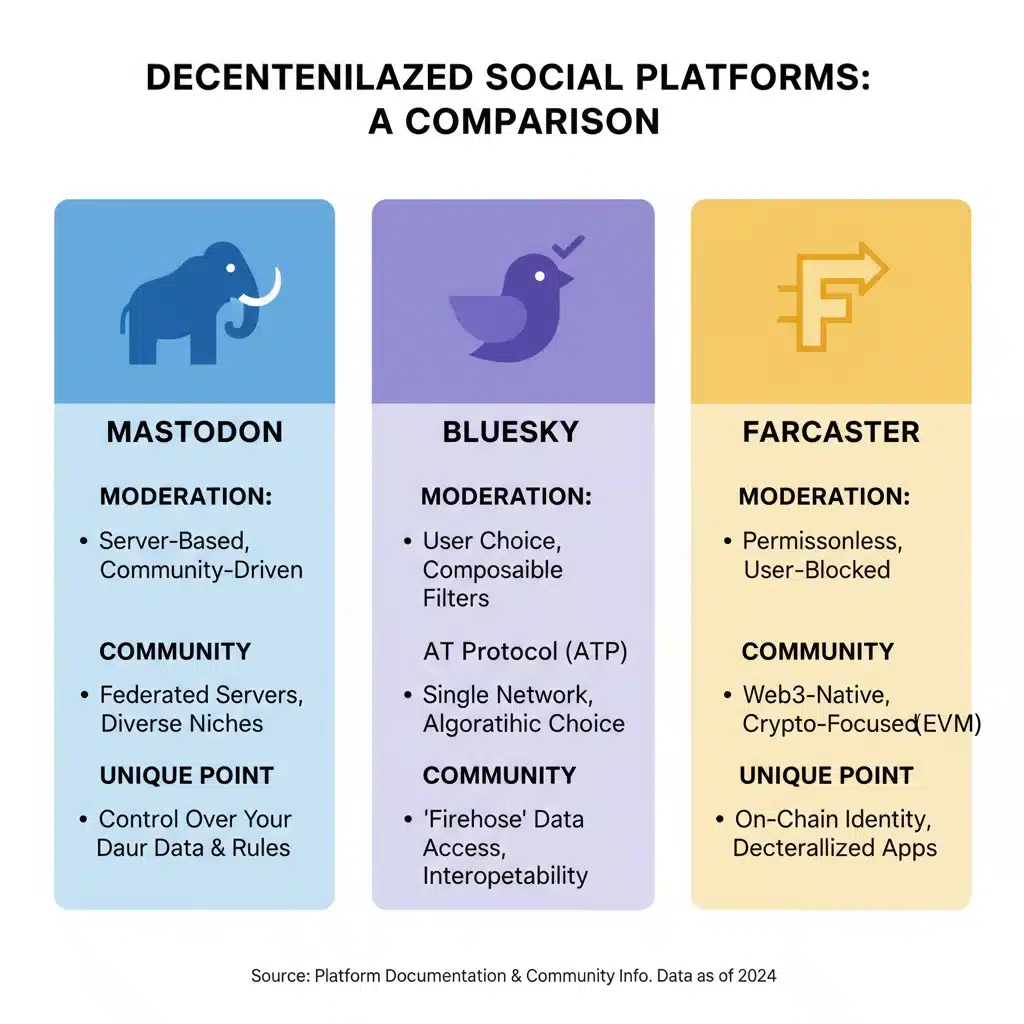
While all three platforms champion decentralized social media, they approach it with distinct philosophies and technical architectures. Understanding these differences is key to appreciating their unique value propositions.
Decentralization Model:
- Mastodon: Highly federated. Thousands of independent instances, each with its own administration. User chooses an instance.
- Bluesky: Federated but with a focus on portable accounts and algorithmic choice. Currently, more centralized in practice with a dominant official client but designed for future decentralization of hosting.
- Farcaster: Blockchain-native. Identity on-chain (Ethereum L2), data off-chain on Hubs. Emphasizes open protocols for developers.
User Onboarding and Experience:
- Mastodon: Can be daunting for newcomers due to instance selection, but offers a highly customizable, community-driven experience.
- Bluesky: Very user-friendly, familiar interface mimicking centralized platforms, making it easier for mainstream adoption.
- Farcaster: Requires an Ethereum wallet, which can be a barrier for non-Web3 users, but offers unique interactive capabilities.
Key Differentiators:
- Mastodon: Strong emphasis on community moderation, diverse instance cultures, and chronological feeds. Its strength lies in its established Fediverse ecosystem.
- Bluesky: Pioneering portable accounts and algorithmic choice, aiming to give users unprecedented control over their social graph and content consumption.
- Farcaster: Deep Web3 integration, blockchain-based identity, and the innovative ‘Frames’ feature that enables interactive mini-apps within posts.
Each of these platforms addresses different facets of the desire for decentralized social media. Mastodon appeals to those seeking community and ethical moderation. Bluesky targets users who want a familiar experience with enhanced control over their data and algorithms. Farcaster is for the Web3 native, looking for truly composable and interactive social experiences built on blockchain.
The Impact of Decentralized Social Media on Digital Freedom and Privacy
The rise of decentralized social media is not merely a technical shift; it’s a movement with profound implications for digital freedom and privacy. For too long, users have traded their data and autonomy for the convenience of connectivity on centralized platforms. These new models offer a potential antidote to many of the problems plaguing the modern internet:
- Enhanced Privacy: By distributing data and control, decentralized platforms reduce the risk of mass data breaches and limit the power of any single entity to surveil user activity. Users often have more control over what information they share and with whom.
- Censorship Resistance: The distributed nature of these networks makes them inherently more resistant to censorship, whether from governments or corporate entities. While individual instances or hubs can still moderate, shutting down an entire network becomes virtually impossible. This is critical for free speech and the open exchange of ideas.
- Algorithmic Transparency and Choice: Moving away from black-box algorithms that dictate what users see is a significant step towards empowering individuals. The ability to choose or even create one’s own algorithms, as envisioned by Bluesky, puts the user back in control of their information diet.
- Data Portability and Self-Sovereignty: The concept of owning your social graph and being able to port it between services, as championed by Bluesky, fundamentally changes the power dynamic. Users are no longer locked into a platform; their digital identity and connections are their own.
- Community Governance: Many decentralized social media projects lean towards community-driven governance and moderation, allowing users to actively participate in shaping the rules and ethos of their online spaces. This fosters a stronger sense of belonging and collective responsibility.
As these platforms mature and gain wider adoption, they push the entire social media industry towards greater transparency and user-centric design. The pressure from decentralized social media alternatives forces centralized platforms to reconsider their own practices regarding privacy, data ownership, and content moderation.

Challenges and the Road Ahead for Decentralized Social Media
Despite their immense potential, decentralized social media platforms face several challenges on their path to mainstream adoption:
- Scalability: Ensuring that decentralized networks can handle the immense traffic and data volume of millions or even billions of users without compromising performance is a continuous technical hurdle.
- User Experience: While platforms like Bluesky are making strides, the onboarding process and overall user experience can still be more complex than centralized alternatives, particularly for non-technical users.
- Moderation: Decentralized moderation is a double-edged sword. While it offers freedom, it also presents challenges in effectively combating spam, hate speech, and illegal content across a distributed network without a central authority. Different instances or hubs often have vastly different approaches.
- Interoperability Standards: While ActivityPub and AT Protocol are steps forward, achieving seamless interoperability across the entire spectrum of decentralized social media platforms remains an ongoing goal.
- Network Effects: Centralized platforms benefit from strong network effects – everyone is already there. Building a critical mass of users on new decentralized platforms requires overcoming this inherent advantage.
However, the rapid innovation and dedicated communities behind Mastodon, Bluesky, Farcaster, and other emerging platforms suggest that these challenges are being actively addressed. The growing awareness among users about data privacy and the desire for more ethical online spaces provide a strong tailwind for decentralized social media. Governments and regulators are also beginning to take notice, with discussions around digital sovereignty and data ownership potentially creating a more favorable environment for decentralized alternatives.