Action Cameras 2026: Unveiling the Best Video Quality from 4 Leading Brands
Action Cameras 2026: A Deep Dive into the Video Quality of 4 Leading Brands
The world of action cameras is constantly evolving, pushing the boundaries of what’s possible in capturing dynamic moments. As we step into 2026, the demand for superior action camera video quality is higher than ever. Enthusiasts and professionals alike seek devices that can withstand extreme conditions while delivering breathtaking, cinematic footage. This comprehensive guide delves into the video quality capabilities of four leading action camera brands – GoPro, Insta360, DJI, and Sony – to help you make an informed decision for your next adventure.
The Evolution of Action Camera Video Quality
Just a few years ago, 4K resolution was considered the pinnacle of action camera video quality. Today, 8K is becoming increasingly standard, and even higher resolutions are on the horizon. But resolution is just one piece of the puzzle. True video quality encompasses a multitude of factors, including dynamic range, color accuracy, low-light performance, and, crucially, image stabilization. In 2026, manufacturers are not just adding more pixels; they are refining every aspect of the image pipeline, from the sensor to the processing chip, to deliver an unparalleled visual experience.
The improvements in sensor technology have allowed for larger sensors in smaller form factors, leading to better light gathering capabilities and reduced noise. Advanced image signal processors (ISPs) are now capable of real-time computational photography, enhancing details, correcting distortions, and applying sophisticated noise reduction algorithms. This means that even in challenging lighting conditions, modern action cameras can produce footage that was once only achievable with much larger, professional-grade equipment. The pursuit of exceptional action camera video quality drives relentless innovation.
Furthermore, the integration of AI and machine learning is playing a more significant role. These technologies are being used to intelligently analyze scenes and adjust camera settings on the fly, ensuring optimal exposure and color rendition. AI-powered stabilization systems are also becoming more sophisticated, capable of predicting movement and compensating for even the most erratic shakes and jitters, resulting in buttery-smooth footage that looks professionally produced. The convergence of hardware advancements and intelligent software is truly transforming what we expect from action camera video quality.
Key Metrics for Evaluating Action Camera Video Quality
When assessing the action camera video quality of any device, several key metrics come into play. Understanding these will empower you to compare brands effectively and determine which camera best suits your needs.
Resolution and Frame Rates
Higher resolution (e.g., 8K, 5.3K, 4K) means more detail in your footage, allowing for greater cropping flexibility in post-production without losing sharpness. High frame rates (e.g., 120fps, 240fps) are crucial for capturing smooth slow-motion footage, adding a dramatic flair to your action shots. The combination of high resolution and high frame rates is a hallmark of premium action camera video quality in 2026.
Dynamic Range (HDR)
Dynamic range refers to the camera’s ability to capture detail in both the brightest highlights and the darkest shadows of a scene. Action cameras often face challenging lighting conditions – bright skies and dark foregrounds, or rapidly changing light as you move through different environments. Excellent dynamic range, often enhanced by HDR (High Dynamic Range) capabilities, ensures that your footage doesn’t have blown-out whites or crushed blacks, preserving more visual information and delivering superior action camera video quality.
Color Science and Accuracy
The way a camera renders colors significantly impacts the overall look and feel of your video. Some brands prioritize vibrant, saturated colors, while others aim for a more natural, true-to-life palette. The best cameras offer profiles that allow users to choose between these, or even shoot in a flat log profile for maximum flexibility in color grading during editing, contributing significantly to professional action camera video quality.
Low-Light Performance
Action doesn’t always happen in broad daylight. Whether it’s a sunset surf session, a night-time bike ride, or exploring a dimly lit cave, good low-light performance is essential. This metric assesses how well a camera can capture detail and minimize noise in challenging low-light conditions. Larger sensors, better lens optics, and advanced noise reduction algorithms are key to achieving superior low-light action camera video quality.
Image Stabilization
Perhaps one of the most critical aspects for an action camera, image stabilization transforms shaky, unwatchable footage into smooth, professional-looking clips. Modern action cameras utilize a combination of optical (OIS), electronic (EIS), and even mechanical (gimbal-like) stabilization. The effectiveness of this feature directly impacts the perceived action camera video quality, making handheld or mounted shots appear as if they were taken with a professional rig.
Bitrate and Compression
Higher bitrates generally mean less compression and therefore more detail and less artifacting in your video files. While high bitrates consume more storage space, they are crucial for preserving the finest details and colors, especially when shooting at high resolutions and frame rates. The codec used (e.g., H.264, H.265) also plays a role in efficiency and quality, influencing the ultimate action camera video quality.
Brand Deep Dive: 4 Leading Action Camera Brands in 2026
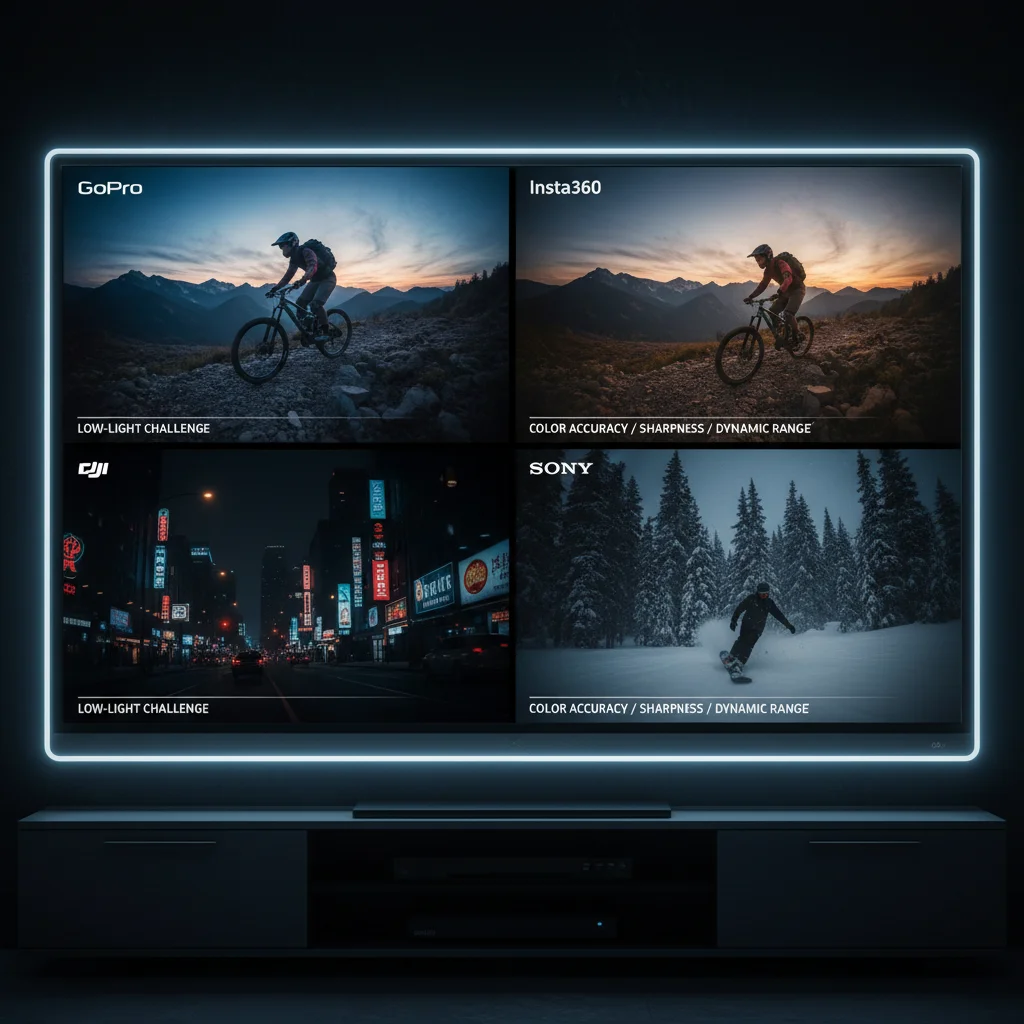
Let’s compare the action camera video quality offerings from the top players in the market for 2026.
1. GoPro: The Enduring King of Action
GoPro has long been synonymous with action cameras, and in 2026, they continue to innovate. Their latest flagship model, the Hero 15, boasts an impressive 8K resolution at 60fps, and 4K up to 240fps for hyper-realistic slow-motion. Their HyperSmooth 7.0 stabilization is, arguably, still the industry benchmark, delivering incredibly stable footage even in the gnarliest conditions. The Hero 15 features a significantly larger sensor than previous models, greatly enhancing its low-light performance, a historical weak point for action cameras. GoPro’s improved GP4 processor also offers advanced tone mapping and color science, producing vibrant, yet natural, colors with excellent dynamic range, solidifying its position in delivering top-tier action camera video quality.
- Resolution & Frame Rates: 8K/60fps, 4K/240fps.
- Stabilization: HyperSmooth 7.0 (electronic with predictive motion algorithms).
- Dynamic Range: Enhanced SuperPhoto + HDR with improved local tone mapping.
- Low-Light: Larger sensor and advanced noise reduction provide significantly cleaner footage.
- Color Science: Vivid and customizable profiles, with a new 10-bit color option for professional grading.
- Key Feature for Video Quality: The seamless integration of hardware and software to produce consistently high-quality, stable footage across various scenarios.
GoPro’s commitment to user experience also means their cameras are incredibly intuitive, allowing users to focus on the action rather than fiddling with settings. This ease of use, combined with cutting-edge action camera video quality, makes them a perennial favorite.
2. Insta360: The Innovator in Versatility and Immersive Capture
Insta360 has carved out a niche by offering unparalleled versatility, particularly with their modular designs and 360-degree capabilities. The Insta360 X5, their 2026 flagship, pushes the boundaries of immersive action camera video quality with 12K 360-degree video, allowing for incredible reframing possibilities in post-production. Their FlowState stabilization, now in its 5th generation, handles extreme motion with remarkable fluidity. For traditional flat video, the X5’s single-lens mod offers 6K at 60fps, and its new ‘PureShot Ultra’ mode leverages computational photography for exceptional low-light detail and dynamic range. Insta360’s strength lies in its ability to capture everything, giving creators immense freedom, all while maintaining exceptional action camera video quality.
- Resolution & Frame Rates: 12K 360-degree/30fps, 6K single lens/60fps.
- Stabilization: FlowState 5.0 (electronic, highly effective for 360 and flat footage).
- Dynamic Range: ‘PureShot Ultra’ for enhanced highlights and shadows in challenging scenes.
- Low-Light: Improved sensor and AI-driven processing for superior detail and reduced noise.
- Color Science: Natural and vibrant, with advanced color profiles for creative control.
- Key Feature for Video Quality: The ability to capture incredibly wide and immersive scenes, then reframing them with professional-grade stabilization and detail.
The flexibility offered by Insta360, allowing users to shoot 360-degree footage and then extract traditional flat video with perfect framing and stabilization, represents a significant leap in creative control and contributes immensely to the perceived action camera video quality.
3. DJI: The Drone Giant’s Grounded Excellence
DJI, renowned for its drones, has successfully translated its imaging expertise into the action camera market with its Osmo Action series. The DJI Osmo Action 6, launching in 2026, focuses on robust build quality and exceptional action camera video quality, particularly in challenging environments. It features a large 1-inch sensor, a rarity in action cameras, enabling outstanding low-light performance and a shallow depth of field for more cinematic looks. It records 5.3K at 120fps and 4K at 240fps. DJI’s RockSteady 5.0 stabilization is incredibly effective, rivaling GoPro’s HyperSmooth, and their D-Log M color profile offers extensive grading possibilities. The Osmo Action 6 also boasts advanced thermal management, allowing for longer recording times at high resolutions without overheating, a critical factor for sustained action camera video quality.
- Resolution & Frame Rates: 5.3K/120fps, 4K/240fps.
- Stabilization: RockSteady 5.0 (electronic, highly effective and smooth).
- Dynamic Range: Excellent, especially with the 1-inch sensor and enhanced HDR processing.
- Low-Light: Class-leading due to the large 1-inch sensor, producing cleaner, more detailed images.
- Color Science: Natural and accurate, with DJI’s renowned D-Log M profile for professional color grading.
- Key Feature for Video Quality: The large 1-inch sensor, providing superior low-light performance and a more cinematic aesthetic previously unseen in action cameras.
DJI’s strength lies in its ability to combine robust hardware with sophisticated software, delivering consistent and high-fidelity action camera video quality that stands up to professional scrutiny, even in demanding conditions.
4. Sony Action Cam: The Unsung Hero of Image Fidelity
While perhaps less mainstream than GoPro or DJI, Sony’s Action Cam series has always been praised by videographers for its exceptional image fidelity and color science. The new Sony FDR-X1000V (2026 model) continues this tradition, focusing on delivering pristine action camera video quality with a more ‘filmic’ look. It features an advanced Exmor R CMOS sensor and a BIONZ X for mobile processor, allowing for 4K at 120fps and 1080p at 480fps for ultra-slow motion. Sony’s Balanced Optical SteadyShot (BOSS) is a unique optical stabilization system that offers gimbal-like smoothness, often outperforming electronic stabilization in certain scenarios. Their ZEISS Tessar lens ensures minimal distortion and excellent sharpness across the frame. Sony’s color science is renowned for its natural, accurate rendition, making it a favorite for those who prioritize true-to-life imagery and exceptional action camera video quality.
- Resolution & Frame Rates: 4K/120fps, 1080p/480fps.
- Stabilization: Balanced Optical SteadyShot (BOSS) – optical stabilization for superior smoothness.
- Dynamic Range: Excellent, with strong highlight retention and natural shadow detail.
- Low-Light: Very good, thanks to the Exmor R sensor and BIONZ X processing.
- Color Science: Natural, accurate, and highly regarded for its filmic quality.
- Key Feature for Video Quality: The unique Balanced Optical SteadyShot (BOSS) and Sony’s renowned color science, delivering a distinctively polished and cinematic look.
Sony’s approach often appeals to those who value optical excellence and a more traditional video production workflow, offering a compelling alternative for those seeking premium action camera video quality with a distinctive aesthetic.
Beyond the Specs: Real-World Performance and User Experience
While specifications are important, the true test of action camera video quality comes in real-world usage. Factors like battery life, ease of use, durability, and ecosystem (accessories, apps) all play a role in the overall experience of capturing and sharing high-quality footage.
GoPro excels in its vast ecosystem of mounts and accessories, making it incredibly versatile for almost any activity. Its intuitive interface and robust app integration simplify the editing and sharing process, ensuring that users can quickly transform their raw footage into polished content. The consistent reliability of GoPro’s stabilization and color science means less time spent correcting issues in post-production, directly contributing to a higher perceived action camera video quality from the user’s perspective.
Insta360’s free-thinking approach to capture offers unparalleled creative freedom. The ability to ‘shoot first, frame later’ with 360-degree footage means you never miss a shot. Their AI-powered editing tools in the app are incredibly powerful, capable of automatically finding the best angles and creating dynamic edits, making professional-looking videos accessible to everyone. This innovative workflow significantly enhances the final perceived action camera video quality, as users can always extract the perfect shot.
DJI’s Osmo Action series stands out for its exceptional build quality and thermal management, which translates to sustained high-resolution recording without throttling. For those pushing their cameras to the limit in extreme temperatures or for extended periods, this reliability is paramount to maintaining consistent action camera video quality. The dual-screen design is also highly practical, especially for vloggers, allowing for easy framing whether you’re behind or in front of the lens.
Sony’s Action Cams, while perhaps having a smaller accessory ecosystem, are favored by those who appreciate their superior optical stabilization and natural color rendition. Their cameras often require a bit more manual control to unlock their full potential, appealing to users who prefer a more hands-on approach to videography. For these users, the slightly steeper learning curve is a small price to pay for the exceptional action camera video quality and filmic aesthetic that Sony delivers.

The Future of Action Camera Video Quality
Looking beyond 2026, the trajectory for action camera video quality is clear. We can anticipate even higher resolutions, potentially 16K, becoming more commonplace, though the practical applications for such high resolutions will continue to be debated. The real innovation will likely come from further advancements in computational photography and AI.
Imagine cameras that can predict your movements with even greater accuracy, anticipating bumps and jitters before they happen to apply pre-emptive stabilization. Or AI that can intelligently enhance specific elements of a scene – brightening faces, sharpening distant landscapes, or reducing atmospheric haze – all in real-time. We’ll also see more sophisticated integration with augmented reality (AR) overlays, allowing for real-time data visualization directly within your footage, adding another layer to the storytelling.
Battery technology will also need to keep pace, as higher resolutions and more powerful processors demand more energy. Expect to see breakthroughs in battery density and faster charging capabilities. Furthermore, the push for eco-friendlier manufacturing and materials will likely influence design and production, without compromising on the pursuit of ultimate action camera video quality.
Connectivity will also evolve. Faster wireless transfer speeds and deeper cloud integration will make it even easier to offload, edit, and share footage on the fly, transforming the entire workflow from capture to consumption. The ability to stream high-quality, stabilized video directly from your action camera with minimal latency will open up new possibilities for live broadcasting of extreme sports and adventures.
The convergence of professional-grade imaging sensors with miniaturized, rugged designs will continue, blurring the lines between consumer action cameras and specialized professional equipment. This means that even amateur adventurers will have access to tools that can produce truly cinematic and inspiring content, further elevating the standard of action camera video quality across the board.
The competition among brands will also drive innovation. As each company strives to differentiate itself, we will see unique features and proprietary technologies emerge that push the boundaries of what an action camera can do. This healthy competition benefits consumers, leading to more powerful, versatile, and higher-quality devices at increasingly competitive price points. The future of action camera video quality promises to be as dynamic and exciting as the action it captures.
Conclusion: Choosing Your Champion for Action Camera Video Quality
In 2026, the landscape of action cameras offers an incredible array of choices, each with its own strengths when it comes to action camera video quality. GoPro continues to be the reliable all-rounder, offering superb stabilization and vibrant colors in a user-friendly package. Insta360 pushes creative boundaries with its immersive 360-degree capture and powerful reframing capabilities. DJI impresses with its robust build, large sensor, and exceptional low-light performance. Sony, the dark horse, appeals to those who prioritize optical stabilization and a natural, filmic aesthetic.
Ultimately, the ‘best’ action camera for video quality depends on your specific needs and priorities. Are you an extreme sports enthusiast who needs bulletproof stabilization and quick sharing? A creative filmmaker looking for unique perspectives and extensive post-production control? Or someone who values pristine image fidelity and low-light prowess above all else?
Whichever brand you choose, rest assured that in 2026, the advancements in action camera video quality mean you’re more empowered than ever to capture your adventures with stunning clarity, vibrant colors, and unparalleled smoothness. The future of action videography is bright, and these leading brands are paving the way for truly unforgettable visual storytelling.